General Grandfather Longcase Clocks
Winding
Most 8 day longcase clocks need to be wound once a week. If you have a weight-driven clock, check the cable or line is not tangled and is properly seated in the groove in the pulley. Generally, the heaviest weight goes on the right side, the next heaviest weight on the left, and the lightest one in the centre. Many clocks use similar weights on the left or left and centre. Always put the heaviest weight on the right.
When winding a weight-driven clock, turn the key slowly to raise the weight. Make sure the cable doesn’t tangle and stop winding just before the pulley at the top of the weight moves out of sight.
When winding a spring-driven clock, turn each winding point until it is tight, and you can feel that it’s at the end of its travel. If you stop short of a full wind, the clock may stop running or chiming before it should.
When winding a 30 Hr clock with chain or rope, these clocks usually have one large weight, the chain or rope is one continuous loop. The furthest section of chain or rope on the right is pulled down to lift the weight. 30 Hr clocks should be would once a day.
Setting the Time
When setting the time on an antique clock, you should move only the minute hand forward, stopping at each hour and half-hour to allow it to strike before advancing it to the next half-hour. If it has a quarter-hour chime, you should also pause at the quarter-hour points to allow the chime to complete its cycle.
Adjusting the Strike or Chime
If you feel the sound of the strike or chime is not right, you can adjust it simply by bending the arm on the strike hammers to bring the hammer head closer or further away from the rod or bell. Usually, you should have about 1/4″ clearance when the hammer is at rest, so that it bounces away after striking the bell or rod, leaving it clear to resonate. Obviously, the harder the hammer hits, the louder the sound.
Putting A Longcase/Grandfather Clock in Beat
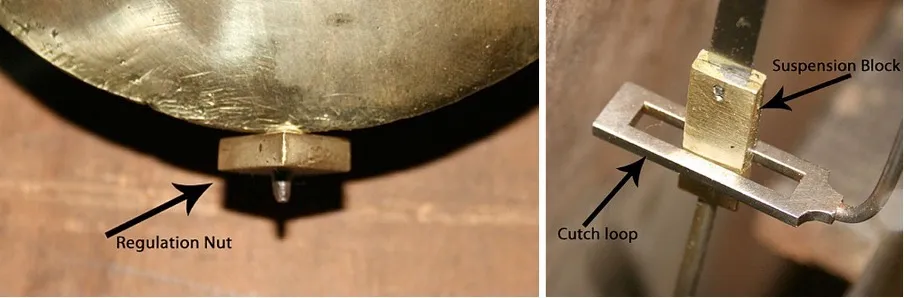
Listen to the tick if the tick is uneven then you will need to adjust the crutch to obtain an “In Beat” tick. Holding the pendulum bob in a central position move the bob to the right and then back to the left. If the longest gap is when the bob is swinging to the right then the crutch needs to be bent to the left and if the longest gap is when the bob is swinging to the left then the crutch needs to be bent to the right. With small adjustments on both sides you should obtain an even tick. If the tick is uneven the clock will usually stop. It’s also important to make sure that the suspension block is in a central position within the crutch loop. Bending the crutch either forward or backwards will solve this problem crutch shown below.
Regulating Your Longcase/Grandfather Clock For Running Speed
To do this you adjust the regulation nut which is at the bottom of the pendulum. If you turn the nut to the right you will speed up the clock and if you turn it to the left you will slow down the clock. You should hold the pendulum shaft with one hand with a little downward pressure and adjust the nut with your other hand so you do not unhook the pendulum.
Maintenance
To maintain the clock you should have it checked and serviced every 4-5 years. Do not attempt to oil a clock yourself. This should be done by a qualified repairer. Over-oiling a clock can affect the running and condition of the clock.